

African Rover Challenge Cars4Mars Rulebook 2027
Revision 1.0
Effective from 14 October 2027
Website and registration
www.cars4mars.co.za
Registration to participate is completed through the official competition website.
Contact person
Ms Basia Nasiorowska - Founder and Organiser
basia@cars4mars.co.za
Competition acknowledgement
Teams must include the competition name, Cars4Mars African Rover Challenge, in all documentation, social media posts, and other promotional materials announcing their participation or awards. The competition must be acknowledged as the only competition of its kind in Africa and the MENA region.
1. Eligibility and team structure
1.1. Student eligibility
1.1.1. The competition is open to teams composed entirely of students who remain actively enrolled in a high school, college, or university program throughout the competition.
1.1.2. A student may be registered as a member of only one team.
1.1.3. The Organizers may request evidence of enrollment and will determine whether a participant meets the eligibility requirements.
1.2. Team composition
1.2.1. The Rulebook does not prescribe a minimum or maximum team size. Limits applicable to specific activities, including command-station participation, are stated separately.
1.2.2. A team may change its registered composition during the competition but must promptly notify the Organizers through the official contact channel. Only registered team members may represent the team in scored competition activities.
1.2.3. By completing team registration, the team and its Team Leader confirm that they have read and accepted this Rulebook and agree to comply with the version in force at the time of each competition activity.
1.3. Team Leader
1.3.1. Each team must appoint one Team Leader, who must be an eligible registered student team member.
1.3.2. The Team Leader is responsible for official communication with the Organizers, communicating official information to the team, and ensuring compliance with the Rulebook.
1.3.3. A change of Team Leader must be reported promptly to the Organizers.
1.3.4. Official competition questions may be sent to Basia Nasiorowska at hello@cars4mars.co.za. Communications sent by the Organizers to the Team Leader or the team’s registered contact address are considered official communications.
1.4. Faculty Advisors and external support
1.4.1. Teams may consult professors, experts, engineers, or other advisers for advice and guidance. Such persons are referred to as Faculty Advisors and are not registered team members.
1.4.2. Engineering decisions, rover design, system integration, testing, and competition operation must be performed by registered student team members.
1.4.3. Commercially available platforms, components, external manufacturing services, laboratories, workshops, and technical services may be used, provided that the engineering decisions, project ownership, system integration, and supervision of the resulting work remain with the student team.
1.4.4. Faculty Advisors and external support providers may not operate the rover or perform scored competition tasks. Additional restrictions applicable during the Mars Stage are provided in Section 6.4.
2. Competition overview
2.1. Competition objective
2.1.1. The objective of the competition is to design, build, and operate a prototype Mars rover.
2.1.2. The rover is not expected to be space-grade or capable of operating in actual Martian or space conditions. It must instead demonstrate the engineering capabilities required by this Rulebook.
2.1.3. The rover must be a mobile, remotely operated system with an independent electrical power source. Detailed Mars Stage requirements are provided in Section 6.2.
2.2. Competition structure
2.2.1. The competition consists of the Launch Stage, held fully online, and the Mars Stage, held in person on 18 September 2027 at SANSA Space Operations, Farm No. 502 JQ, Hartebeeshoek, Krugersdorp 1740, South Africa.
2.2.2. The two stages have separate scoring, rankings, awards, and prizes. Launch Stage points are not transferred to the Mars Stage.
2.2.3. A team may compete in the Launch Stage even if it does not plan to attend the Mars Stage.
2.3. Launch Stage
2.3.1. During the Launch Stage, teams design, build, and demonstrate their rovers through written reports, a video submission, and, for invited teams, a live online Final Presentation.
2.3.2. The Launch Stage evaluates the quality of the team’s engineering work and the rover’s demonstrated readiness for the Mars Stage missions. Detailed rules are provided in Section 5.
2.4. Qualification for the Mars Stage
2.4.1. The number of teams invited to the Mars Stage is determined by the Organizers. Invitations are offered according to the final Launch Stage ranking and applicable eligibility requirements.
2.4.2. If an invited team declines or cannot accept its Mars Stage place, the invitation passes to the next eligible team in the Launch Stage ranking. The declining team retains its Launch Stage ranking, awards, and prizes.
2.5. Mars Stage
2.5.1. The Mars Stage is an in-person competition in which teams operate their rovers in the Traversal Mission and Autonomous Mission.
2.5.2. The Mars Stage has its own ranking, awards, and prizes. Detailed rules are provided in Section 6.
3. Competition schedule
3.1. Schedule overview
3.1.1. The table below summarizes the key competition dates. Detailed Launch Stage submission requirements are provided in Section 5, and the official Mars Stage schedule will be communicated by the Organizers.
3.1.2. Launch Stage deadlines expire at the time specified in Rule 5.1.2 unless the Organizers expressly state otherwise.
| Stage | Event | Date / deadline |
|---|---|---|
| Launch Stage Online | Team registration | 30 April 2027 |
| Project Strategy Report | 31 May 2027 | |
| Final Design Report + Video Submission | 2 August 2027 | |
| Launch Stage Final qualification announcement | 14 August 2027 | |
| Launch Stage Final | 21 August 2027 | |
| Mars Stage In person - SANSA Space Operations, Krugersdorp 1740, South Africa | Mars Stage Final | 18 September 2027 |
4. Scoring
4.1. General scoring rules
4.1.1. Launch Stage and Mars Stage scores are calculated separately and are not combined.
4.1.2. Qualification for the Launch Stage Final is based on the 300 points available before the Final Presentation. Invited finalists may earn up to 100 additional points, for a maximum Launch Stage score of 400 points.
4.1.3. The maximum Mars Stage score is 400 points. Launch Stage points are not transferred to the Mars Stage.
4.1.4. Detailed scoring and evaluation rules are provided in Sections 5 and 6.
4.1.5. Unless a specific rule states otherwise, a score calculated after applying all applicable multipliers and deductions is rounded to the nearest whole point. A result ending in 0.5 is rounded up.
| Competition stage | Scoring component | Maximum points |
|---|---|---|
| Launch Stage | Project Strategy Report | 50 |
| Launch Stage | Final Design Report | 50 |
| Launch Stage | Video Submission | 200 |
| Launch Stage | Maximum before the Launch Stage Final | 300 |
| Launch Stage Final | Final Presentation - invited teams only | 100 |
| Launch Stage | Maximum for finalists | 400 |
| Mars Stage | Traversal Mission | 250 |
| Mars Stage | Autonomous Mission | 150 |
| Mars Stage | Total | 400 |
5. Launch Stage
The Launch Stage is a standalone online competition with its own scoring, ranking, and awards.
Participation is mandatory for teams seeking qualification for the Mars Stage. The Launch Stage evaluates the quality, maturity, and Mars Stage readiness of each rover based on the submitted materials.
Teams may score up to 300 points for the Project Strategy Report, Final Design Report, and Video Submission. The highest-ranked teams will be invited to the Launch Stage Final Presentation, where they may score up to 100 additional points. Final ranking and qualification are determined under Section 5.8.
5.1. General rules
5.1.1. All Launch Stage deliverables must be prepared and submitted in English.
5.1.2. Unless stated otherwise, all deadlines expire at 23:59:59 (UTC+2) on the date indicated.
5.1.3. All required deliverables must be submitted through the official forms provided by the Organizers. Submissions sent by e-mail or by any other means will not be accepted unless explicitly permitted by the Organizers.
5.1.4. All deliverables applicable to a team at a given point in the competition are mandatory. The consequences of failing to submit a required deliverable are set out in Section 5.3.
5.1.5. The rover presented during the Launch Stage should be designed for the Mars Stage missions. Teams may significantly improve, modify, or rebuild it before the Mars Stage, provided that it remains part of the same registered team project and continues to be engineered, integrated, and supervised by the team in accordance with Section 1.4. The Organizers may request evidence of this continuity.
5.1.6. Submitted materials and competition representations must be the team’s own work except for third-party content, tools, components, and contributions that are appropriately identified or credited. Teams must have the rights and permissions required to use all submitted content.
5.1.7. Generative AI and other external tools may be used. The team remains responsible for the accuracy, originality, and compliance of the resulting work, must appropriately identify material AI-generated or third-party contributions, and must be able to explain and defend the submitted technical content.
5.1.8. Deliberate falsification, plagiarism, manipulation, misrepresentation, or unauthorized use of third-party content may result in 0 points for the affected deliverable or disqualification from the competition.
5.1.9. The team retains ownership of its intellectual property. By submitting materials, the team grants the Organizers a non-exclusive, royalty-free right to reproduce, display, publish, and distribute those materials for administering, documenting, and promoting the competition, subject to applicable law and consent requirements.
5.1.10. Teams are responsible for obtaining any permissions required from team members and third parties. Personal data will be processed in accordance with the privacy information provided during registration, and recording or publication of identifiable participants remains subject to applicable consent requirements.
5.1.11. The Organizers may interpret these rules, request clarification or verification materials, and verify compliance with the competition requirements. Decisions of the Organizers and judges are final.
5.2. Deliverables and deadlines
5.2.1. During the Launch Stage, teams are required to submit the following deliverables:
| Deliverable / Event | Deadline |
|---|---|
| Team registration | 30 April 2027 |
| Project Strategy Report | 31 May 2027 |
| Final Design Report + Video Submission | 2 August 2027 |
| Launch Stage Final Presentation | 21 August 2027 |
5.2.2. The Project Strategy Report must be submitted through its official form. The Final Design Report and Video Submission must be submitted together through a single official form, with the video provided as a YouTube link. The Launch Stage Final Presentation will be held live online.
5.2.3. Team registration is mandatory but not scored. A team that has not completed registration is ineligible to participate unless expressly permitted by the Organizers.
5.3. Submission and evaluation rules
5.3.1. To receive full consideration, teams must submit complete, accessible, and verifiable materials in accordance with this Rulebook and the official submission forms.
5.3.2. Submissions received by the deadline are eligible for full points. Late submissions remain eligible for evaluation but are subject to a point deduction determined by the judges according to the duration of the delay. Exceptionally late submissions may not be evaluated.
5.3.3. Teams should use the six-page limit to present their strongest and most relevant evidence. Every PDF page counts toward the limit, including cover pages, tables of contents, and appendices. Only the first six pages will be evaluated, and exceeding the limit may result in a format-compliance deduction. Content available only through external links will not be evaluated.
5.3.4. Submitted materials may not be replaced or materially modified after the deadline unless requested or authorized by the Organizers. Technical corrections to file or link access settings may be permitted if the submitted content remains unchanged.
5.3.5. Failure to submit a required deliverable results in 0 points for that deliverable and default exclusion from further participation. In exceptional circumstances, the judges may allow the team to continue, but the score for the missing deliverable remains 0.
5.3.6. Submissions meeting all format and access requirements are eligible for full evaluation. Invalid or inaccessible links, incorrect file formats, missing required sections, or use of an unauthorized submission channel may limit the material the judges can evaluate and may result in a point deduction or rejection.
5.3.7. The Organizers may request clarification or verification materials, including photographs, raw footage, screen recordings, or a live online demonstration.
5.3.8. Teams can maximize their score by providing clear and credible evidence of rover functionality. Judges will award points only for capabilities that can be verified from the submitted materials.
5.4. Project Strategy Report
Official template: https://docs.google.com/document/d/13_Zhs5jT3yP4n_xoB1GgH9oTAOJsRIptrTlwmh6zVqQ/edit?usp=sharing
Submission form: https://forms.gle/PHQCwEBMLAnfLg218
5.4.1. The Project Strategy Report presents the team’s challenge strategy and initial rover concept, including key design considerations and intended readiness for the Mars Stage missions. It is worth a maximum of 50 points and should be concise and focused on the most important engineering and strategic aspects.
5.4.2. Teams must use the official template and complete all required sections.
5.4.3. The report may include text and graphics, such as diagrams, sketches, renders, tables, or photographs.
5.4.4. Format requirements:
- PDF format
- A4 page size
- maximum 6 pages
- minimum font size: 11 pt
- minimum margins: 2.54 cm (1 inch)
5.5. Final Design Report
Official template: https://docs.google.com/document/d/1aWdqIMGEgKKXUXR_FGPpaCFInk_tk3E2hrbbrf7GElg/edit?usp=sharing
Submission form: https://forms.gle/GmRo7J5s5dZtMxPQ7
5.5.1. The Final Design Report presents the rover as it exists at submission, including its final design, key technical and operational decisions, and expected readiness for the Mars Stage missions. It is worth a maximum of 50 points, and claims should be supported by technical justification, visuals, or test results where possible.
5.5.2. Teams must use the official template and complete all required sections, including the Mars Readiness Review.
5.5.3. Format requirements:
- PDF format
- A4 page size
- maximum 6 pages
- minimum font size: 11 pt
- minimum margins: 2.54 cm (1 inch)
5.5.4. The report must accurately represent the rover’s current state at the submission deadline.
5.6. Video Submission
Submission form: https://forms.gle/GmRo7J5s5dZtMxPQ7
5.6.1. The Video Submission demonstrates the rover in action and provides evidence of its readiness for the Traversal and Autonomous Missions. It is worth a maximum of 200 points.
5.6.2. Teams decide which capabilities to present and how to demonstrate them. The examples below are guidance, not a mandatory checklist; evaluation is based on the strength of the evidence of actual Mars Stage readiness.
5.6.3. Video requirements:
- maximum length: 5 minutes; if the video is longer, only the first 5 minutes will be evaluated
- language: English
- the video must be published on YouTube as either Public or Unlisted; teams are encouraged to publish it publicly
- the submitted link must remain active and accessible to the Organizers and judges until the final Launch Stage results are published
- the official Cars4Mars logo must be clearly visible either as a watermark during the video or at both the beginning and the end; videos meeting this requirement are eligible for full consideration, while missing or insufficient logo placement may result in a point deduction determined by the judges
5.6.4. Teams are encouraged to demonstrate, where relevant:
- driving forward and backward
- turning and avoiding obstacles
- wireless control of the rover
- live video transmitted wirelessly from onboard cameras
- transporting a 1 kg object in an onboard container
- driving on uneven or difficult terrain
- detecting and classifying relevant objects visible on rover cameras
- detecting balloons of different colors and determining their position in the image
- autonomous driving from one balloon to another on flat terrain
5.6.5. Teams can maximize their score by presenting clear, credible, and continuous evidence of rover capabilities. Integrated demonstrations of multiple rover systems may provide stronger evidence than isolated demonstrations. Judges will award points only for capabilities that can be verified from the video.
5.6.6. The Video Submission will be assessed using the following scoring categories:
| Scoring category | Max points |
|---|---|
| Readiness for the Traversal Mission | 100 |
| Readiness for the Autonomous Mission | 60 |
| System integration and reliability | 25 |
| Credibility and clarity of evidence | 15 |
5.6.7. Production quality is not scored except where it affects verification. For key capabilities, teams are encouraged to use clear, continuous footage and, when demonstrating wireless control or video transmission, to show the rover and operators simultaneously where possible.
5.7. Launch Stage Final Presentation
5.7.1. The Launch Stage Final Presentation gives the highest-ranked teams an opportunity to earn up to 100 additional points by presenting their rover, engineering decisions, project development, and answers to the judges. Teams are selected based on their combined score of up to 300 points for the Project Strategy Report, Final Design Report, and Video Submission. The number of invited teams will be determined by the Organizers.
5.7.2. Participation is mandatory for invited teams. Failure to participate results in 0 points for the Final Presentation and, by default, exclusion from further participation. In exceptional circumstances, the judges may allow the team to remain classified. If allowed to remain classified, the team retains its earlier score out of 300 points and receives 0 points for the Final Presentation.
5.7.3. The presentation is the final showcase of the Launch Stage and may be attended by judges, other teams, and invited guests. It may be livestreamed, recorded, and published by the Organizers, subject to any consent requirements communicated in advance.
5.7.4. Each team has up to 10 minutes for its live presentation, followed by a 5-minute question-and-answer session. The presentation will be stopped at 10 minutes, and any unpresented content will not be considered.
5.7.5. The presentation must be delivered live and in English using the platform specified by the Organizers. Teams must use and screen-share their own visual materials; advance file submission is not required. Access details, schedule, team order, and technical instructions will be communicated to invited teams.
5.7.6. Any number of registered student team members may attend, present, and answer questions. Faculty Advisors and other non-registered persons may observe but may not present, answer questions, communicate answers, or otherwise assist during the team’s slot.
5.7.7. Teams may include videos, animations, pre-recorded clips, or an optional live rover demonstration. All such content counts toward the 10-minute limit and receives no separate bonus points.
5.7.8. Teams may present improvements made after the Final Design Report and Video Submission deadline if clearly identified and supported by credible evidence. Teams should address:
- their project management approach
- the final rover design
- key lessons learned during the challenge
- possible future improvements, development directions, or commercialization ideas
5.7.9. During the 5-minute question-and-answer session, judges may direct questions to any registered student team member.
5.7.10. In the event of technical difficulties, the team will be allowed one reconnection attempt and a pause of up to 5 minutes. If the issue is beyond the team’s reasonable control, the judges may allow the presentation to continue later or be rescheduled.
5.7.11. The Launch Stage Final Presentation is worth a maximum of 100 points and will be assessed using the following scoring categories:
| Scoring category | Max points |
|---|---|
| Final rover design and technical justification | 35 |
| Project management and lessons learned | 20 |
| Answers to judges’ questions | 25 |
| Future improvements and development plans | 10 |
| Clarity and structure of the presentation | 10 |
5.8. Final ranking and qualification for the Mars Stage
5.8.1. The final Launch Stage ranking is based on the total number of points earned in all applicable Launch Stage deliverables. Invited finalists may score up to 400 points, while teams not invited to the Final Presentation retain their score out of 300 points.
5.8.2. The highest-ranked teams that remain eligible under Sections 5.3 and 5.7 will be invited to the Mars Stage. The number of invitations will be determined by the Organizers.
5.8.3. If two or more teams have the same total score, the higher-ranked team will be determined by, in order: the higher Video Submission score, the higher Final Design Report score, the higher Project Strategy Report score, and, if the tie remains, a decision of the judges.
5.8.4. An invited team must confirm acceptance of its Mars Stage invitation through the method stated in the invitation within 7 calendar days of receiving it. Failure to confirm within this period is treated as declining the invitation.
5.8.5. A team that declines or does not confirm an invitation retains its final Launch Stage ranking, awards, and prizes. The invitation will pass to the next eligible team in the Launch Stage ranking.
6. Mars Stage
6.1. General rules
6.1.1. The Mars Stage is a standalone in-person competition with its own scoring, ranking, awards, and prizes. It will take place on 18 September 2027 at SANSA Space Operations, Farm No. 502 JQ, Hartebeeshoek, Krugersdorp 1740, South Africa. Points earned during the Launch Stage are not transferred to the Mars Stage.
6.1.2. The Mars Stage consists of two missions: the Traversal Mission, worth up to 250 points, and the Autonomous Mission, worth up to 150 points. A team may score up to 400 points in total.
| Mission | Max points |
|---|---|
| Traversal Mission | 250 |
| Autonomous Mission | 150 |
| Total | 400 |
6.1.3. Each team has one attempt at each mission. Mission order and assigned time slots will be communicated in the official schedule.
6.1.4. Teams must report on time for their assigned slot. Late arrival reduces the time available and may result in loss of the attempt. The Organizers may exceptionally offer another available slot, but teams should not rely on this possibility.
6.1.5. For the purposes of this Rulebook, the Marsyard is the marked competition area containing the mission course and mission objects. Its detailed layout may differ from the diagrams, but the tasks will remain consistent with the mission descriptions. The Organizers may modify, shorten, postpone, or stop a mission because of weather, safety, technical conditions, or other circumstances affecting fair competition.
6.1.6. Points are awarded for completed results. A team retains points earned before skipping, ending, or timing out of a mission unless a specific rule provides otherwise.
6.2. Rover requirements
6.2.1. In its starting configuration, the rover must not exceed 80 cm in width, 80 cm in length, 250 cm in height, or 40 kg in mass. The height limit includes communication masts and other equipment.
6.2.2. The rover will be weighed and measured before competing. Everything installed on or carried by the rover at that time counts toward the limits. Equipment located in the command station and mission objects placed on the rover by judges do not count.
6.2.3. After weighing and measurement, no new equipment may be added to the rover. Components already included in the measured configuration may be deployed, extended, or reconfigured after the mission begins.
6.2.4. Identical spare parts may be used for repairs. A significant change determined by a judge requires the rover to be weighed and measured again.
6.2.5. A non-compliant rover may be permitted to compete subject to a point deduction determined by the judges according to the scale of non-compliance. A rover presenting a safety risk will not be permitted to start.
6.2.6. The rover must be a standalone platform powered by electrical batteries and operated remotely from the command station. Combustion engines and radioactive power sources are prohibited.
6.2.7. The rover will remain within 80 m of the command station; the expected operating distance will normally not exceed approximately 30 m.
6.2.8. The rover must have an onboard container capable of transporting an object weighing up to 1 kg and fitting within a 40 × 40 × 40 cm volume. Mission objects will be placed in and removed from the container by a judge.
6.2.9. Teams may use commercially available platforms, components, and subsystems. The complete rover must be integrated, configured, and developed by the team as its own engineering system.
6.3. Mission slots and setup
6.3.1. Each mission is assigned a fixed 40-minute slot beginning when setup starts and ending 40 minutes later.
6.3.2. The first 10 minutes are allocated for setup. If a team declares readiness earlier, its operation clock begins immediately but it may not use the remaining setup time for mission operation. If the team has not declared readiness by the end of the first 10 minutes, its operation clock begins automatically and continues while the team completes setup. The fixed 40-minute slot does not restart.
6.3.3. During setup, teams may power, move, and test the rover outside the Marsyard but may not drive it on the Marsyard.
6.3.4. Scored mission operation and the mission-specific rules begin when the team declares readiness and begins its attempt. The rover must be fully behind the designated start line at that moment. A team that continues setup after the first 10 minutes remains subject to the setup rules, but its operation clock continues to run.
6.3.5. The operation clock runs continuously from the earlier of the team’s declaration of readiness or the end of the first 10 minutes. It does not pause except when a judge pauses it under Rule 6.5.7. The mission ends at the end of the assigned slot or when the team declares that it has finished.
6.3.6. At the end of the mission, all activity must stop immediately. An incomplete task does not score unless its description expressly awards points for a completed sub-result.
6.3.7. A team may be assigned a slot any time during the competition day. The team must be ready to make an attempt during the slot assigned according to the schedule published by the organisers. The organisers reserve the right to deny changing the schedule upon the team's request. The organizers will make every effort to ensure that teams have at least a one-hour break between missions.
6.4. Command station and communication
6.4.1. Teams will operate from a tented command station next to the Marsyard. The Organizers will provide a desk, chairs, protection from weather, and a standard type M power outlet. Teams are responsible for any required adapters.
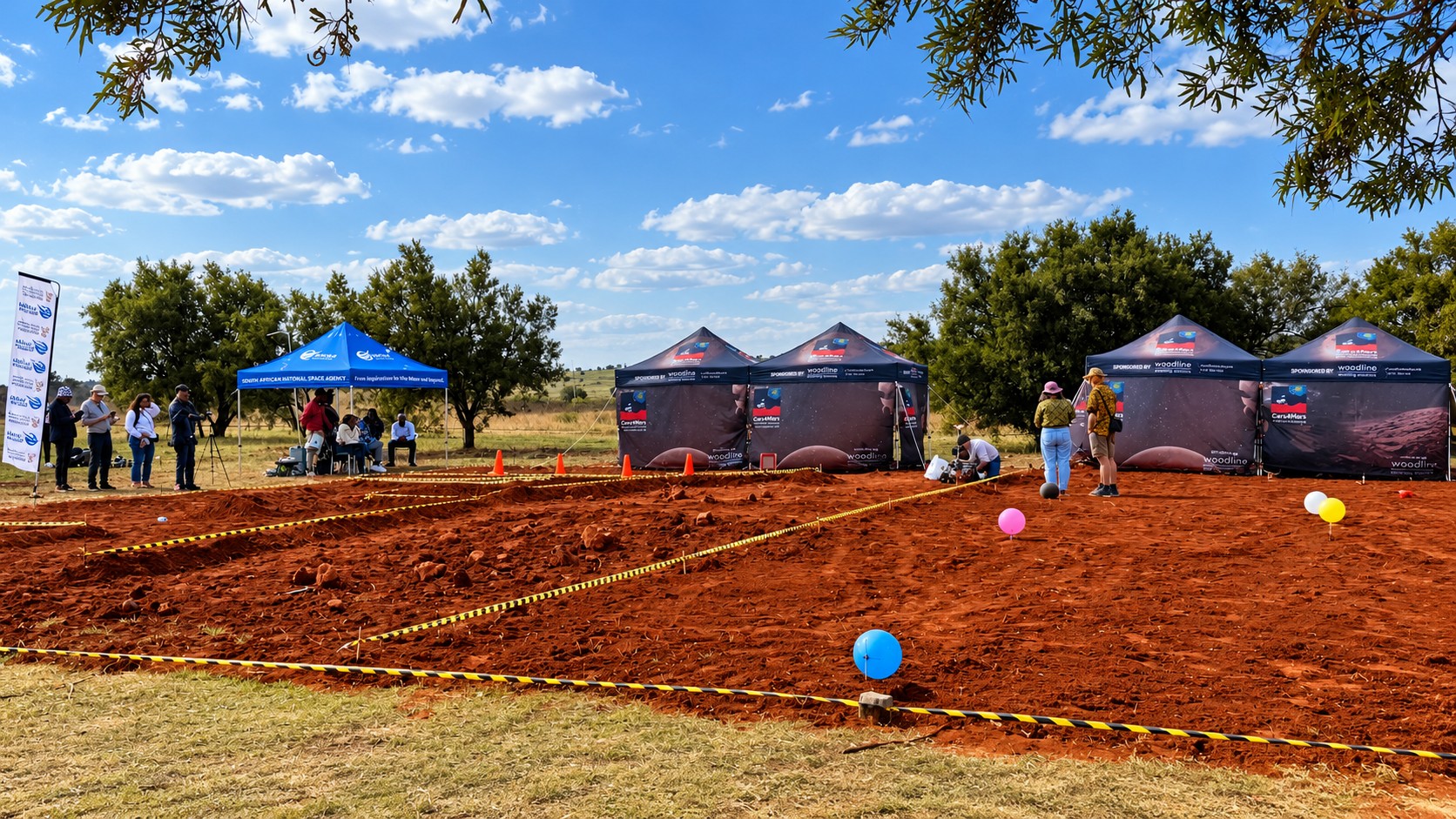
6.4.2. Up to five registered student team members may be present in the command station. They may use computers, controllers, monitors, and other equipment needed to operate the rover.
6.4.3. A judge will remain in the command station during the mission.
6.4.4. Faculty Advisors do not count toward the five-person limit and may observe from the command station or designated on-site areas. They may not operate equipment, advise the team, communicate information, assist with troubleshooting, or participate in an intervention.
6.4.5. After mission operation begins, no person may enter the command station. A team member or Faculty Advisor who leaves may not return until the mission ends.
6.4.6. During mission operation, persons inside the command station may communicate only with each other and the judge. No communication is permitted between persons inside the command station and any person outside it, including registered team members who leave after switching to direct line-of-sight. Communication with Faculty Advisors, spectators, or other external persons may result in 0 points for the affected task or another penalty determined by the judges.
6.4.7. Teams are responsible for their own communication system. The Organizers do not guarantee Wi-Fi or internet access. Mobile internet and satellite internet, including Starlink, are permitted, but may not be used to communicate with any person not authorized under Rules 6.4.6 and 6.4.13.
6.4.8. Teams must comply with applicable radio and telecommunications regulations. The Organizers may require a team to change frequency, reduce power, relocate equipment, or stop using a device that causes interference.
6.4.9. Antennas, masts, and other communication equipment may be placed within 10 m of the command station during setup. They may not be touched or moved after mission operation begins unless the team requests an intervention.
6.4.10. In camera-only operation, the team’s direct view of the Marsyard will be blocked and all points are available.
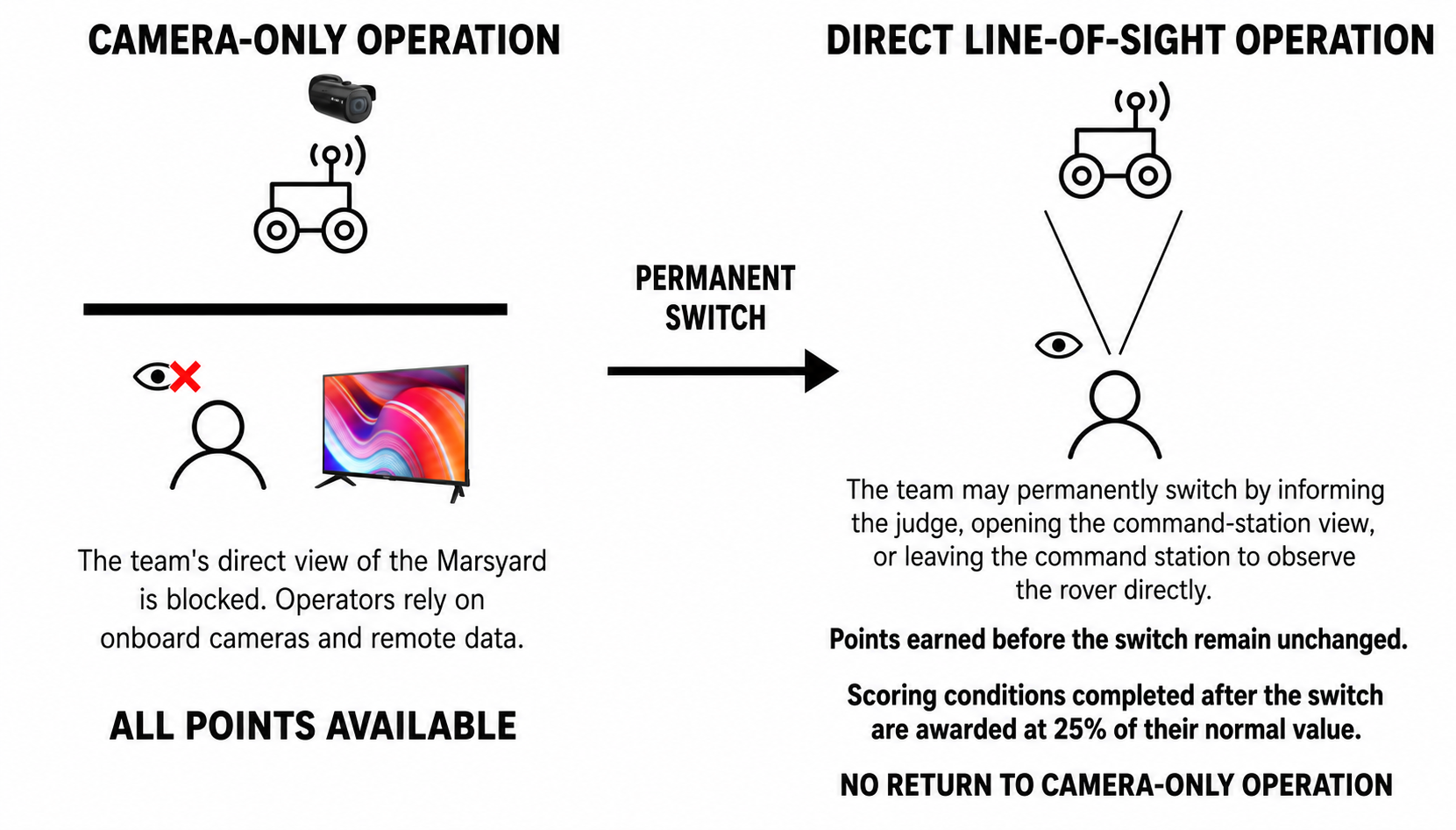
6.4.11. A team may permanently switch to direct line-of-sight operation by informing the judge, opening the command station view, or leaving the command station to observe the rover directly, whichever occurs first. The team may not return to camera-only operation.
6.4.12. Points earned before the switch remain unchanged. A scoring condition satisfied after the switch, including a bonus, is awarded at 25% of its normal value, regardless of when the attempt began.
6.4.13. Any number of the operators already present may leave the command station after switching to direct line-of-sight and may move only within areas designated by the judges. They may not touch the rover without an intervention. Operators outside the command station may not communicate with anyone inside it or with any person other than the judges and registered operators who are also outside the command station.
6.5. Safety, interventions, and Marsyard boundaries
6.5.1. A judge may require the rover to stop immediately or may suspend or terminate a mission whenever necessary for safety, fairness, or protection of the Marsyard and competition equipment.
6.5.2. A team may request an intervention through the judge. No person may enter the Marsyard or touch the rover until the judge grants permission.
6.5.3. Up to four registered student team members may participate in an intervention. Faculty Advisors may not participate.
6.5.4. During an intervention, the team may repair the rover, replace a battery or component with an identical spare, adjust communication equipment, and perform other necessary work approved by the judge.
6.5.5. The judge will determine whether the rover resumes from the place of intervention or a previous checkpoint. The rover may not make progress by being moved during the intervention. Mission time continues to run during a team-requested intervention.
6.5.6. The number of interventions is not limited. For each team-requested intervention, the mission score is multiplied by 0.8. The multipliers are applied successively; after n interventions, the intervention multiplier is 0.8^n.
6.5.7. A judge-initiated intervention for reasons beyond the team’s control carries no deduction, and the judge may pause the mission time when appropriate. A judge-initiated stop caused by the rover, the team’s actions, or an unsafe condition attributable to the team may be treated as a team-requested intervention, or the mission may be suspended or terminated, as determined by the judge.
6.5.8. The rover leaves the Marsyard when any part of it crosses the marked boundary line. Leaving the Marsyard multiplies the mission score by 0.75. This deduction is applied no more than once per mission. If returning the rover also requires an intervention, both multipliers apply.
6.5.9. Contact with a person, competition infrastructure, or an unsafe area will result in an immediate stop and assessment by the judges. This immediate-stop rule does not apply to contact with a mission obstacle for which a specific scoring consequence is stated, unless the judge determines that the contact creates a safety risk.
6.5.10. Task points are calculated first, including the direct line-of-sight multiplier where applicable. The result is then multiplied by 0.8 for each team-requested intervention and by 0.75 if the Marsyard-boundary deduction applies. The final score cannot be lower than 0.
6.6. Traversal Mission
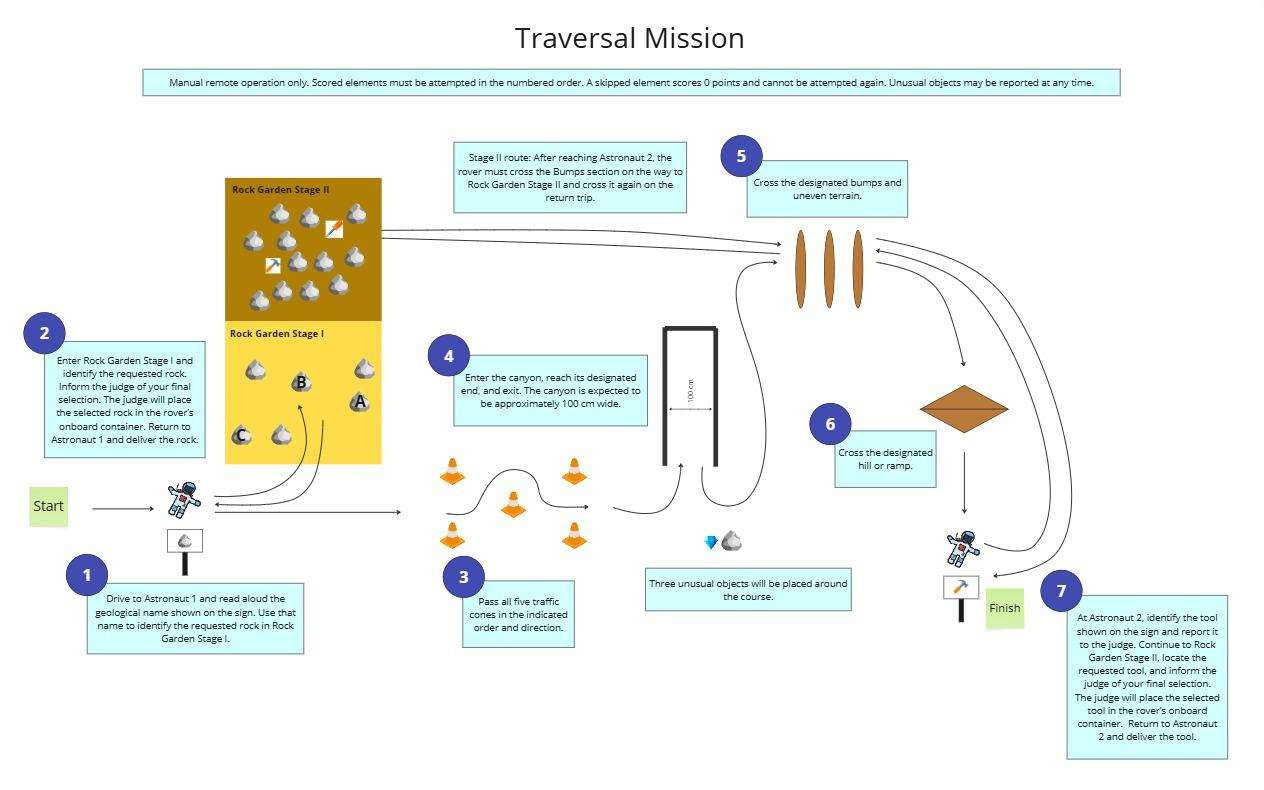
6.6.1. The Traversal Mission is worth up to 250 points and must be completed by manual remote operation. Autonomous operation is not permitted during this mission.
6.6.2. The mission follows a defined route, and its scored elements must be attempted in the order described below. A team may skip a scored element by informing the judge. If the team does not respond or does not proceed, the judge may declare that element skipped. A skipped element scores 0 points and cannot be attempted again.
6.6.3. The unusual-object scoring conditions are exempt from the required task order and may be completed at any time during the Traversal Mission.
6.6.4. Astronaut 1 and Rock Garden Stage I. The team must read aloud the geological name shown on the astronaut’s sign, enter Rock Garden Stage I, identify the matching rock, and inform the judge of its final selection. The judge will place the selected rock in the rover’s onboard container. The rover must then deliver the rock to Astronaut 1.
6.6.5. Slalom. The rover must pass five traffic cones in the indicated order and direction. The no-contact bonus requires completion without touching any cone.
6.6.6. Canyon. The rover must enter the canyon, reach its designated end, and exit. The canyon is expected to be approximately 100 cm wide. The front-first bonus requires the rover to exit with its front facing the exit. The no-contact bonus requires the rover to complete the canyon without touching its walls.
6.6.7. Bumps. The rover must cross the designated bumps and uneven terrain. The maximum expected obstacle height is 30 cm and the maximum expected slope is 30 degrees.
6.6.8. Hill or ramp. The rover must cross the designated hill or ramp. The maximum expected height is 1 m and the maximum expected slope is 45 degrees.
6.6.9. Astronaut 2. The team must identify the tool shown on the astronaut’s sign and communicate its answer to the judge. The possible tools are a hammer, screwdriver, and file.
6.6.10. Rock Garden Stage II and tool delivery. The rover must travel from Astronaut 2 to Rock Garden Stage II, locate the requested tool, and inform the judge of its final selection. The judge will place the selected tool in the rover’s onboard container, after which the rover must return it to Astronaut 2. Rock Garden Stage II will provide a more difficult navigation environment than Stage I. The Bumps section must be crossed in both directions; the slalom, canyon, and hill or ramp may be bypassed. Bumps points are awarded only for the initial scored crossing. The later crossings award no additional points, and a skipped Bumps element cannot be recovered later in the mission.
6.6.11. Three unusual objects will be placed around the course. To score for an object, an operator must verbally describe the object and its location to the judge in the command station. Each object may be scored only once.
6.6.12. Contact with a traffic cone or canyon wall affects only the corresponding no-contact bonus. Other points remain available when their scoring conditions are met.
6.6.13. The Traversal Mission will be scored as follows:
| Mission element | Scoring condition | Points |
|---|---|---|
| Astronaut 1 / Rock Garden Stage I | Rock name reported (5); requested rock identified (5); any selected rock delivered (10); correct-rock bonus (5) | 25 |
| Slalom | Course completed (10); no-contact bonus (5) | 15 |
| Canyon | Designated end reached (10); canyon exited (5); front-first bonus (5); no-contact bonus (10) | 30 |
| Bumps | Initial scored crossing completed | 35 |
| Hill or ramp | Obstacle completed | 50 |
| Astronaut 2 / Rock Garden Stage II | Correct tool identification (5); requested tool located and identified (25); requested tool delivered (50) | 80 |
| Unusual objects (3) | Each correctly described object and location; 5 points each, maximum three objects | 15 |
| Total | 250 |
6.7. Autonomous Mission
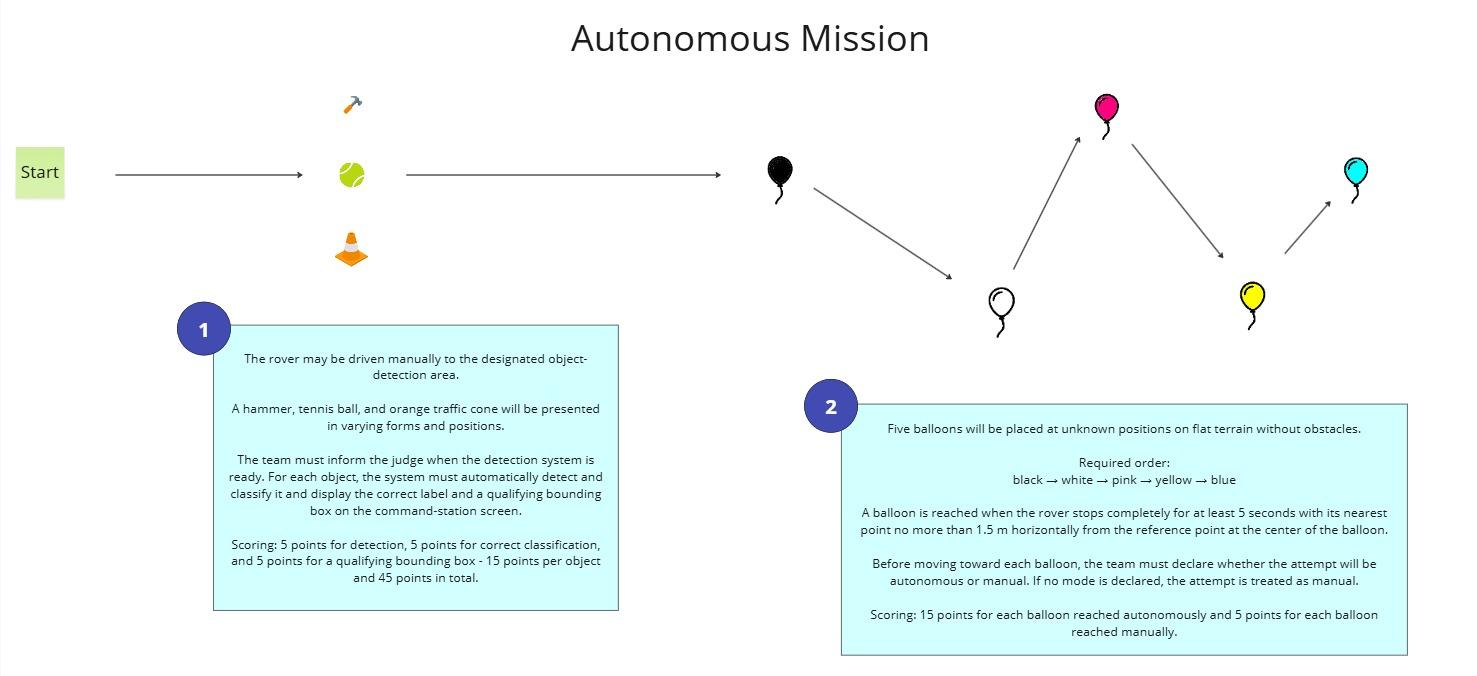
6.7.1. The Autonomous Mission is worth up to 150 points and consists of automatic object detection followed by navigation between colored balloons.
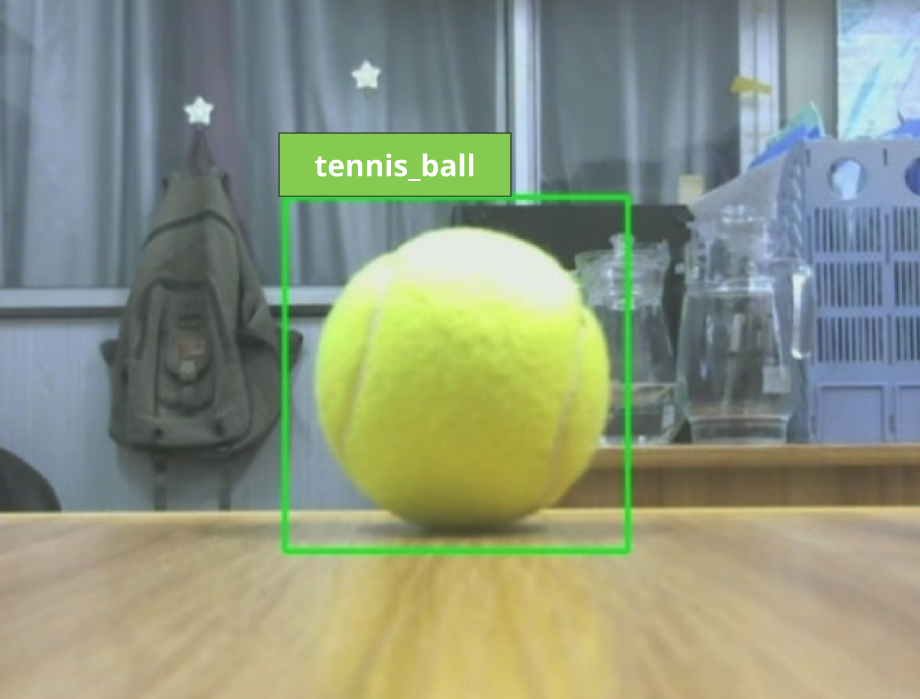
6.7.2. For object detection, the rover may be driven manually to the designated area. A hammer, tennis ball, and orange traffic cone will be presented in varying forms and positions.
6.7.3. For each object, the system must automatically detect and classify the object and display the correct label and a bounding box on the command-station screen. The bounding box must clearly enclose the target object without primarily covering unrelated objects, as determined by the judge. Detection, correct classification, and a qualifying bounding box are each worth 5 points, for a maximum of 15 points per object and 45 points in total.
6.7.4. Detection processing may run onboard the rover or on a computer in the command station. Operators may use the interface, but detection and classification must be performed automatically.
6.7.5. The team must inform the judge when the detection system is ready. Judges may reposition or change the presented object variants between teams while maintaining comparable task difficulty.
6.7.6. For balloon navigation, five balloons will be placed at unknown positions on flat terrain without obstacles. The required order is black, white, pink, yellow, and blue.
6.7.7. A balloon is reached when the rover stops completely for at least 5 seconds with its nearest point no more than 1.5 m horizontally from the reference point at the center of the balloon.
6.7.8. Each balloon may be attempted autonomously or manually. Points are awarded separately for each balloon, as shown in the scoring table.
6.7.9. Before moving toward a balloon, the team must inform the judge whether the attempt will be autonomous or manual. If no mode is declared, the attempt is treated as manual. The team may change mode between balloons.
6.7.10. During autonomous operation, no team member may issue driving commands, select steering actions, modify the route, or otherwise influence rover motion. A single start command is permitted, and autonomous computation may run in the command station.
6.7.11. A human driving command during an autonomous attempt changes the current balloon attempt to manual. A software stop, emergency stop, or repeated start command does not by itself change the attempt to manual, provided that the commands do not encode direction, select a route, or use timing to guide the rover.
6.7.12. A balloon is skipped when the team informs the judge that it is skipping it, proceeds toward a later balloon, or does not respond or make progress and the judge declares it skipped. A skipped balloon or a balloon approached out of sequence scores 0 points and cannot later be recovered. The team may continue toward the next required balloon.
6.7.13. A balloon that is touched, displaced, or knocked over by the rover before the scoring condition in Rule 6.7.7 is satisfied scores 0 points and cannot later be recovered. The team may continue toward the next required balloon.
6.7.14. The Fully Autonomous Sequence bonus is awarded only when all five balloons are reached in the correct order without manual driving or a physical intervention during the balloon sequence. Software start and stop commands do not remove the bonus if they do not influence steering or route selection.
6.7.15. The Autonomous Mission will be scored as follows:
| Scoring category | Max points |
|---|---|
| Automatic object detection - 5 points each for detection, correct classification, and a qualifying bounding box; 15 points per object, 45 points in total | 45 |
| Balloon navigation - 15 per autonomous balloon; 5 per manual balloon | 75 |
| Fully Autonomous Sequence bonus | 30 |
| Total | 150 |
6.8. Mars Stage results and ranking
6.8.1. A team’s Mars Stage score is the sum of its final Traversal Mission and Autonomous Mission scores after all applicable multipliers and deductions. The maximum total is 400 points.
6.8.2. Teams are ranked by total Mars Stage score. If two or more teams have the same score, the team with the shorter combined completion time for both missions ranks higher. If the tie remains, the judges will decide the final order.
6.8.3. For tie-breaking purposes, completion time is measured from the moment the operation clock begins under Rules 6.3.2 and 6.3.5 until the team completes the mission or declares that it has finished. A team that does not complete a mission is assigned 40 minutes for that mission.
6.8.4. Teams will receive their mission score sheets by e-mail. Score sheets are informational and are not subject to protest or appeal.
6.8.5. Teams will be informed of the final ranking order during the awards ceremony. Detailed scoring results will be provided after the competition.
6.8.6. Decisions of the Organizers and judges regarding mission execution, scoring, safety, and final ranking are final.
7. Guidance from the judges
7.1. Purpose and status
7.1.1. This section provides non-binding recommendations intended to help teams prepare for the competition. It does not create additional eligibility, scoring, technical, or operational requirements.
7.1.2. If this guidance conflicts with any other provision of the Rulebook or an official communication from the Organizers, the applicable competition rule or official communication prevails.
7.1.3. Teams should review the complete Rulebook before finalizing rover requirements, project plans, and submission materials. Questions may be submitted through the official contact channel.
7.2. Team and project planning
7.2.1. Teams are encouraged to combine complementary technical and organizational skills and to define responsibilities clearly.
7.2.2. Teams should maintain a realistic development schedule, review progress regularly, and prioritize reliable core functionality before optional or advanced features.
7.2.3. A team does not need to begin with all the required knowledge. Research, iteration, and learning are expected parts of the project.
7.3. Development and testing
7.3.1. Teams should test early and incrementally, verifying each component and subsystem before full integration.
7.3.2. Particular attention should be given to mobility, remote control, video transmission, power systems, and functions directly relevant to the Launch Stage evidence and Mars Stage missions.
7.3.3. Testing should, where practical, reproduce expected operating conditions and include recovery from foreseeable failures.
7.4. Support and logistics
7.4.1. Teams may seek institutional, technical, or financial support in accordance with Section 1.4.
7.4.2. Teams planning to attend the Mars Stage should prepare travel, rover transport, accommodation, and funding arrangements as early as practicable. The Mars Stage Final will take place on 18 September 2027 at SANSA Space Operations, Farm No. 502 JQ, Hartebeeshoek, Krugersdorp 1740, South Africa.
7.4.3. Unless the Organizers state otherwise, teams should plan to provide the networking, internet-access, and other communication equipment required to operate their rover in accordance with Section 6.4.